
LGR
Local Government Reorganisation
What is Local Government Reorganisation?
There are currently 15 council across Hampshire and the Isle of Wight. The Government wants to simplify this by creating fewer, larger councils. Each council would be a unitary council, responsible for providing all the services in our local area - currently some services are run by Eastleigh Borough Council and some by Hampshire County Council.
The proposals for Hampshire & Isle of Wight
Eastleigh Borough Council worked with 10 other councils across Hampshire to submit a joint proposal to government as part of Local Government Reorganisation plans in September 2026 to create five new councils in total: built around the four anchor cities and towns in the region - Portsmouth, Southampton, Winchester and Basingstoke, with the Isle of Wight as a separate unitary council, as it is already.
The proposal was for councils that fit the way people live - fewer layers, less confusion, and decisions made closer to home, so services are simpler, stronger, and more responsive to local needs. They would also be large enough to succeed, with the scale and financial sustainability to deliver quality services and invest for the long term.
Government Decision
The Government has published its decision on how local councils in Hampshire, the Isle of Wight, Portsmouth and Southampton will be reorganised.
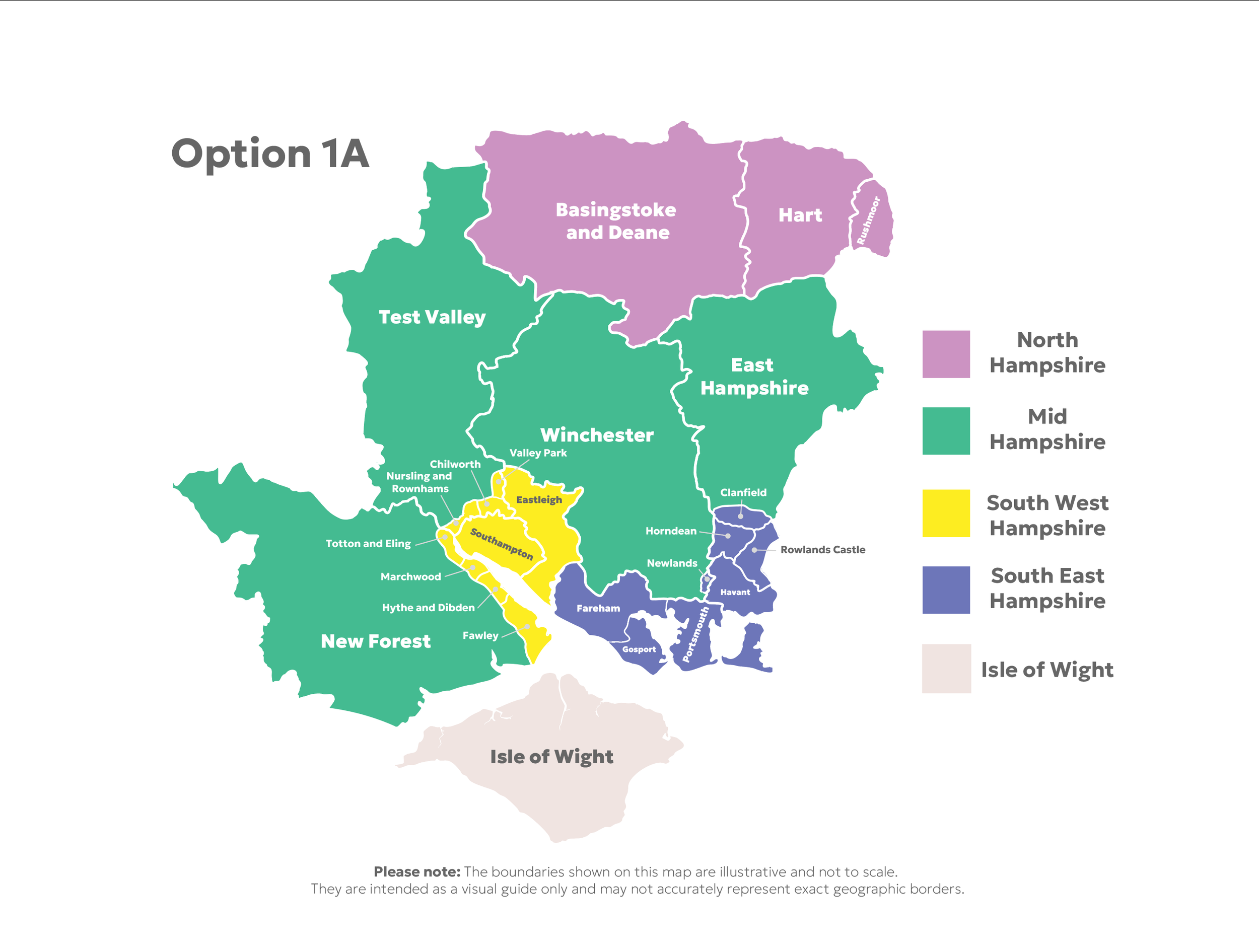
The Government intends to implement Option 1A, creating five unitary councils with targeted boundary changes around Southampton & Portsmouth. This is the place-based model we have supported: services close to communities, with councils large enough to be sustainable.
Option 1A will see Eastleigh & Southampton come together with the parishes of Chilworth, Fawley, Hythe and Dibden, Marchwood, Nursling and Rownhams, Totton and Eling, and Valley Park to create a new South West Hampshire unitary authority:
Eastleigh supported this option because it:
-
Brings together similar communities – reflecting how people actually live, work and travel
-
Creates a council that is big enough to be financially resilient, but not so big that it becomes remote
-
Aligns with local hospitals, transport links, ports and airports – supporting economic growth
-
Creates councils with balanced populations and tax bases, giving each council a more even mix of housing, businesses and residents which is important for long-term resilience
-
Still keeps Isle of Wight as a separate council and maintains a North Hampshire unitary.
Nothing changes overnight. There are legal and practical steps before any new council starts, and services continue as normal for now.