

How we manage our green spaces
What green spaces do we manage?
Our teams manage around 265 hectares of green spaces across the Borough. This includes sports pitches, parks, play areas, wildlife meadows, roadside verges and community spaces. Our green spaces team cut grass on all Hampshire County Council highway verges, Borough owned open spaces, recreation grounds and countryside sites.
You will see us cutting grass between March and October but not every green space needs the same cutting regime.
Benefits of our green space management
The Council is now taking a more environmentally friendly approach to grass cutting that includes specific cutting regimes that are tailored to specific areas.
This new grass cutting approach balances leisure use, appearance of the street environment and at the same time encourages more biodiversity.
This new approach to grass cutting will also be a learning opportunity for us - so it will be kept under review and feedback will be invited from residents and communities to help us get it right.
Benefits for people and wildlife
- encourage greater biodiversity – some areas may not be cut as often -this will support the local environment and encourage biodiversity.
- increase carbon capture
- more opportunities for connection with nature
- interest and colour in urban environments
- the grass is cut into smaller pieces by a flail mower compared to a cylinder mower – the smaller pieces will break down quicker returning nutrients to the soil
When the grass will be cut
You will see our green spaces team cutting grass between March and October, however, the final cuts can take place as late as November if the weather and ground conditions have affected our cutting schedule.
In our parks and in local areas where grass is used for recreation, we cut grass regularly depending on the ground and weather conditions.
Green spaces that are not used for sport or recreation will receive less cuts and will be managed for nature instead.
We are working with nature, sometimes the cutting cycle can start earlier or later during the year depending on ground and weather conditions.
For example:
- Recreation grounds, sports pitches, cemeteries grass will be maintained on a two weekly cycle from March to October
- Highway verges, parts of public open spaces - grass will be maintained on a 4–5-weekly cycle from March to October
- Conservation areas - public open spaces such as the old golf course, countryside sites will be cut once a year from August to October
Please note these schedules are dependent on weather and ground conditions. If areas are not cut when planned the teams will be back as soon as possible to complete the work when weather and ground conditions permit.
Green spaces management map
Please note:
We’re currently transferring some green spaces to town and parish councils so they can manage them locally. We update the map as often as we can, but there may be mistakes while transfers are still underway.
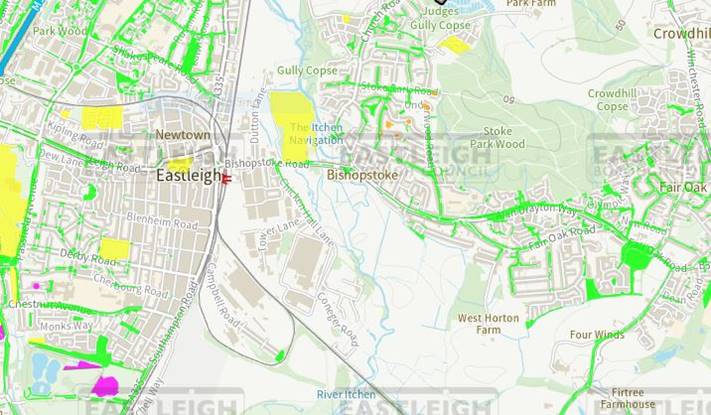
The grass mowing map is designed to allow residents to quickly and easily find out those areas that the Council is responsible for grass mowing together with how regularly they are cut.
- yellow areas will be mowed on a two week grass cutting cycle
- green areas will be mowed on a four to five week grass cutting cycle
- pink areas are designated as conservation areas and will be mowed annually
You can:
- zoom in to see more detail using the blue navigation tools
- search for an address in the search box provided
Frequently Asked Questions
Strimming around street furniture such as lamp posts and street name signs usually takes place a couple of days or so after the area has been mowed by a different team.
You can, however you should be aware of the possible risk of injury to yourself, passing pedestrians and traffic.
Planting on highways verges requires a license. You will need to contact Hampshire County Council Highways to apply for a licence https://www.hants.gov.uk/transport/licencesandpermits/planting if the land abuts the Highway.
This could be because:
- it is suffering from a problem such as localised water logging
- it is not always possible to finish a whole estate in one day and the team may need to come back the next day to finish off
- the land may belong to someone else, be in private ownership or be on a different route
- the area has wild flowers and/or bulb plantings and is cut on a different frequency
- it may require a smaller pedestrian mower or may be cut by larger equipment such as a tractor fitted with gang mower
Removing and disposing of the grass cuttings requires extra mowers and vehicles, which burn fossil fuels and therefore have a negative impact on our environment and climate change targets. Leaving the cuttings is better for the grass; the cuttings rot down and release nutrients into the soil which that strengthens the grass.
Grass cutting is a large-scale operation and needs to be carried out in all conditions, cutting can be suspended if conditions become so bad that the ground would be damaged or if there is a risk to staff’s welfare.
We wait until six weeks after the flowering period before mowing spring flowers, such as daffodils, this allows food reserves in the bulb to be replenished before the following seasons flower buds are formed, this ensures the bulb continues to flower each year
The Council has already decided to reduce the frequency of grass cutting across the borough to monthly to allow verges and open spaces to grow longer to help improve bio-diversity and increase wildflowers for pollinators. So there is no requirement for the Council to support 'No mow May'.
We have an increasing number of biodiversity areas across the borough. Some of these are open wildflower areas and some are long grass under trees. Long grass under trees has fewer flowers but is still very important habitat for wildlife and helps protect trees.
We are not responsible for cutting the grass on:
- privately-owned land (including land owned by housing associations, or developments not yet adopted by us)
- land in the borough owned by town and parish councils
- land outside of our borough
Please report grass mowing issues on private land or other publicly owned land direct to the owners.
Grass mowing is predominantly carried out with flail mowers, flail mowers are able to cut longer grass into smaller lengths, which speeds up the composting of the mowing.
Grass cuttings which fall onto hard surface areas are left for a follow-up team who blow the grass off pavements and paths back on to the grassed areas within two working days.
Grass cuttings from within and around children's play areas and equipment are collected.
Tackling the climate and ecological emergencies
- Benefits to wildlife
Grasslands contain many wildflowers including species such as dandelions and daisies these are often thought of as ‘weeds’. However long grass and wildflowers are good for wildlife, they provide food and shelter for insects, birds, small mammals, reptiles and amphibians and they also provide flowers for pollinators. - Benefits to the environment
Grasslands slow down and absorb the flow of rainwater which can reduce the risk of flooding, they also help to cool down our urban areas during heat waves. Storms and heat waves are likely to become more frequent and severe due to climate change. - Mowing grass less often
Mowing the grass less often gives wildflowers the chance to flower and produce seeds. It also reduces air and noise pollution from grass cutting equipment and reduces the amount of fossil fuel that is burned. In some areas, we have reduced our mowing frequency to 1 or 2 cuts per year. - Mowing wildflower or meadow grass at the right time
It is best to cut grass after the flowers have bloomed and produced seeds, which is usually from August onwards. A cut in early spring can also help wildflowers as long as they haven’t started to flower yet. We cut our long grass between August and October. - Reducing nutrients and avoiding chemicals
After mowing wildflower or meadow grass, it is best to remove the grass clippings if possible, as these can cover up the wildflowers making it harder for them to grow. Grass clippings also add nutrients to the soil which are not good for wildflowers as the nutrients cause a small number of species to thrive and overtake the other species. Adding fertiliser should be avoided for the same reason. - We are only able to remove grass clippings at a small number of our sites that have been identified as good quality wildflower meadows.